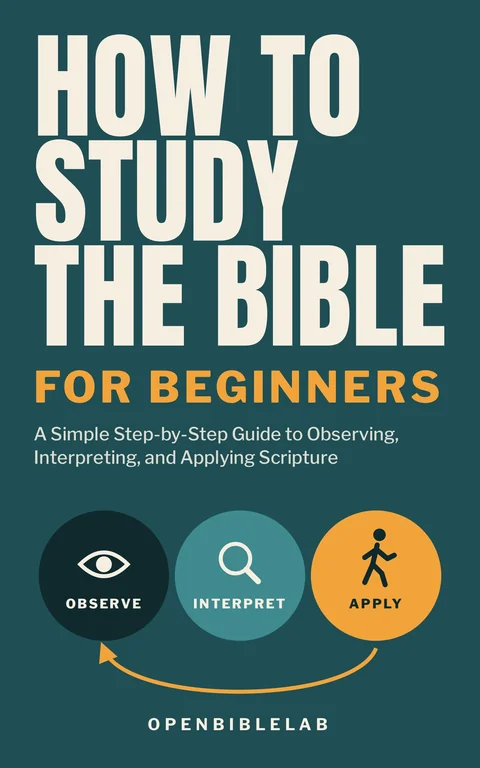
Most of us were taught to read the Bible but never taught to study it. We skim a chapter, feel vaguely encouraged or vaguely confused, and move on. This guide walks you through a simple, repeatable method that works on any passage of Scripture, whether you have been reading for forty years or you opened a Bible for the first time this week.
What Is the OIA Method?
OIA stands for Observation, Interpretation, and Application. It is a three-step method for studying any Bible passage: first you look carefully at what the text says, then you ask what it means in its original context, and finally you ask how you should respond.
The method is sometimes called inductive Bible study, and it has been taught in churches, seminaries, and small groups for generations. It is not owned by any denomination or organization. It is simply careful reading made deliberate. The order of the steps matters. When we skip straight from reading a verse to asking what it means "to me," we tend to hear our own thoughts echoed back. When we slow down, observe first, and interpret in context, we give the text a chance to say something we did not already believe.
The three steps are easy to remember as three questions. What does the text say? What does it mean? How should I respond? Everything else in this guide is just practical help for asking those questions well.
Step 1: Observation. What Does the Text Say?
Observation means reading the passage slowly, several times, and writing down what is actually there before deciding what it means. Nothing more complicated than that. It is the most skipped step in Bible study, and it is also the one that changes everything.
Pick a short passage. A paragraph is plenty. Read it three or four times, and if you can, read it out loud once. Then start noticing. Who is speaking, and to whom? What words or ideas repeat? Are there contrasts, like light and darkness, or flesh and spirit? Are there commands? Promises? Questions? Pay special attention to small connecting words such as therefore, because, so that, and but. Those little words carry the logic of a passage, and following them is often the fastest way to understand it.
Write your observations down. A short list of ten plain observations, things like "Paul says rejoice twice" or "this sentence begins with therefore," will serve you far better than a vague impression. At this stage, resist the urge to explain anything. You are gathering evidence, not drawing conclusions. Good observation makes the next step almost easy.
Step 2: Interpretation. What Does It Mean?
Interpretation means asking what the passage meant to its original author and audience, then stating that meaning in your own words. The goal is a single clear sentence: the main point of the passage.
Context does most of the work here. Read the paragraphs before and after your passage. Ask why the author is saying this at this point in the book, and what problem or situation he is addressing. A promise written to a suffering church means something different than the same words would mean on a coffee mug. You do not need to be a scholar to do this. You need to be curious, and you need to keep asking why until the passage holds together.
Two habits will keep your interpretation honest. First, let your observations lead. If your conclusion is not supported by things you actually saw in the text, hold it loosely. Second, let Scripture interpret Scripture. The Bible is one unfolding story, and a single verse read against the whole tends to be a verse misread. When you are unsure, a book overview or a study Bible introduction can supply the background you are missing in a few minutes.
Then write your one sentence. "This passage teaches that..." Finishing that sentence is the whole test. If you cannot finish it yet, you are not behind. You just have more observing to do.
Step 3: Application. How Should I Respond?
Application means responding to the meaning you found, not to a feeling the words gave you. Once you know what the passage taught its first readers, you ask what it asks of you.
Three questions help. What does this passage show me about God? What does it call me to believe? What does it call me to do? Not every passage produces a to-do item, and that is fine. Sometimes the truest application is worship, or repentance, or simply trusting something you had forgotten. But when a passage does call for action, make your response concrete. "Be more loving" evaporates by lunchtime. "Call my brother this week" does not.
One honest, specific application is worth ten inspiring generalities. Write it down, and when you return to the passage later, you will be able to see how God has been working in you through it. This is also where studying with other people helps. Sharing an application out loud, in a group or a community, has a way of making it real.
What Does OIA Look Like on a Real Verse?
Here is the full method applied to one short verse, Philippians 4:13. In the American Standard Version it reads, "I can do all things in him that strengtheneth me." It is one of the most quoted verses in the Bible, and studying it carefully shows why context matters so much.
Observation. Paul is speaking in the first person: "I can do all things." The strength is not his own. It comes from someone else, "in him that strengtheneth me." And the verse does not stand alone. In the verses just before it, Paul says he has learned to be content in every circumstance, whether he is well fed or hungry, whether he has plenty or is in need. He is writing from prison. The word "learned" appears twice.
Interpretation. In context, "all things" refers to the circumstances Paul just listed: abundance and hunger, comfort and hardship. The verse is not a promise of success in any venture we choose. It is a testimony of contentment. The main point in one sentence: Christ gives his people the strength to be content and faithful in every circumstance, high or low.
Application. The honest questions become: where am I relying on my circumstances for peace instead of on Christ? What hard situation am I facing right now where I need his strength rather than an escape? A concrete response might be to name that situation in prayer this week and ask for contentment in it, not just deliverance from it.
Notice what happened. A verse that is often used as a slogan about achievement turned out to be something better: a promise of Christ's sustaining strength in every season. That is what careful study does. It trades a smaller, borrowed meaning for the real one.
How Long Does It Take to Study the Bible This Way?
A focused OIA study of a short passage takes about twenty to forty minutes. That is enough time to read the passage several times, write a handful of observations, work out the main point, and settle on one application.
The method scales with the time you have. On a busy morning, ten minutes with a single verse is a real study, not a lesser one. On a slower weekend, you might spend an hour in a full chapter. What matters is not the length of any one session but the rhythm across weeks and months. Three short studies a week will do more for your understanding of Scripture in a year than a heroic effort every January that fades by February. Expect the early sessions to feel slow. Like any skill, observation speeds up with practice, and after a few weeks you will start seeing things in the text almost automatically.
What Tools Do You Need to Study the Bible?
You need three things: a Bible you can read comfortably, something to write with, and unhurried time. Everything else is optional.
That said, a few extras genuinely help. A second translation lets you compare wording, which often surfaces details a single translation hides. A study Bible or a short book overview supplies historical background, like who wrote a book, to whom, and why, without requiring hours of research. A notebook dedicated to your studies becomes more valuable every month you use it, because you can look back and watch your understanding grow.
What you do not need: knowledge of Greek or Hebrew, a shelf of commentaries, or a seminary degree. Those things have their place, and commentaries are a fine way to check your conclusions after you have done your own work. But the method is built on tools every reader already has, which is exactly the point. If you want a guided starting place, our free Bible study courses and book-by-book guides were built for this.
Where Should a Beginner Start?
Start with a short New Testament book and study one paragraph at a time. The Gospel of John, Philippians, or James are all good first choices: they are rich, readable, and short enough to finish.
Before you begin a book, take a few minutes to get oriented. Watch or read a short overview so you know who wrote it, who received it, and what it is about. Our free New Testament and Old Testament guides exist for exactly this. Then work through the book slowly with the three steps, a paragraph or a scene per sitting, writing as you go.
Two more suggestions. First, take the free How to Study the Bible course, where the OIA method is taught step by step in short video lessons you can watch at your own pace. Second, do not study alone forever. Questions get answered faster, applications get more honest, and the whole practice gets more joyful when you share it. The free OpenBibleLab community is a good place to do that.
The Bible rewards patient readers. Start small, stay consistent, and let the three questions do their quiet work. What does it say? What does it mean? How should I respond?